About this history & its evidence
This is an independent research synthesis, not an official lore book. It covers the story through the 1.0 release of 15 October 2026.
Recorded means a statement occurs in a journal text, tutorial, or official announcement. A character's claim remains that character's testimony. Interpretation identifies a connection inferred from several records. Unresolved means the sources examined do not establish the answer.
The journal texts were read through online transcriptions, principally GameVault; they were not checked against a local 1.0 installation. The boss names were cross-checked against a database that reports extracting game data. The detailed ending is supported by community accounts of the final sequence, with that limitation noted below. Dates use the game's D.A. notation; no expansion of the abbreviation or conversion to our calendar is assumed.
CHAPTER 01
Historical overview
Embervale's catastrophe began before its human rulers dug the Elixir Wells. An Ancient origin account describes visitors following a fallen fragment of their star, becoming trapped, and investigating a buried, living danger. Much later, the Wanderer made the Elixir an instrument of human ambition. Political rivalry, extraction, and war allowed the Shroud to engulf the realm. Legacy of the Ancients
The Ancients were divided over their duty to humanity. Their council considered remaining apart; Ezramin argued for solidarity. The Flameborn emerged from cooperation between humans and younger Ancients. The final conflict brings this alternative to the Wanderer's domination into focus: a person carrying Ancient fire confronts a ruler becoming the Wanderer's vessel. Council proceedings, Ezramin, Metamorphism
CHAPTER 02
Timeline
A chronology of Embervale, from the Ancients to the 1.0 finale. In-world dates retain the D.A. notation. Undated events have approximate placement and may overlap.
Undated ancient past
An Ancient account describes a fragment of their star falling into a promising world. They follow it, then find their departure blocked. Attempts to escape and a search underground lead to a buried living threat, subsequently sealed away. The account uses poetic language; its cosmology should not be reduced to a literal technical diagram.
Undated Ancient research
Manathor's expedition investigates a transformative organism and distils blue Elixir. A sample disappears; a fabric scrap carries biological material matching the organism. The record hints at an intruder, without naming one. Its exact placement relative to the origin account is uncertain.
432 D.A., first day of Yearwake
Ethan is selected as a Scholar of the Empyrean. This documents an established channel of contact between humans and Ancients before the catastrophe.
492 D.A., 49th day of Midyear
The Wanderer visits Lord Vorgoth. Vorgoth drinks the offered blue liquid and experiences levitation.
After that audience; exact year unstated
Vorgoth introduces Elixir to Gormander and pressures Jezmina. His account credits the Wanderer with the Well blueprints.
498 D.A.
Balthazar observes Well construction and irritating fumes. Extraction is already causing visible harm.
500–501 D.A.
Balthazar records the spreading Shroud and develops a spore explanation for its transmission.
503 D.A.
Eldermere reports inadequate energy production and polluted water at the dam, showing that Ancient infrastructure is under strain too.
By 505 D.A.
Balthazar reports the Ancient capital has risen. The ascent is therefore already underway or visible by this date.
Undated stages of the ascent
Claravinta records a council split, insufficient power, and the Shroud reaching the elevated settlement. Ancients offer their bodies as fuel. These stages overlap the wider collapse; their precise dates are unestablished.
506–508 D.A.
Cinder Vessel trials progress from failure in 506, to a successful animal subject in 507, to a blacksmith volunteering as the first human prototype in 508.
During the collapse; undated
Jezmina travels with Ancients, intending to place Cinder Vessels beyond Embervale's shores. She knows Vorgoth is heading toward the risen islands.
509 D.A., days 8 and 26 of Yearwake
Loraine enters Cinder's Cradle after Rimgard's forces breach a barrier. She studies the ascent platform and its distant power sources.
512 D.A., days 1–20 of Midyear
Captain Arkwright guards a Cinder Vault, repels Scavengers, and destroys the bridge to protect its occupants. This also cuts off his soldiers' supplies.
After the finale
The immediate threat is overcome and rebuilding gains new hope. The Shroud and Fell remain. This is the conclusion of the current story, rather than universal cleansing.
The present year is unassigned here. Do not convert these dates into elapsed years using a guessed date for the player’s awakening.
CHAPTER 03
Main character biographies
The people and powers behind the catastrophe—and those who preserved a future.
Lord Vorgoth
Guard of the North, ruler of Rimgard
Vorgoth is an authoritarian ruler whose suspicion of the Ancients precedes his first recorded drink. The Wanderer exploits that existing hostility, offering power framed as something the Ancients withheld. Vorgoth becomes a promoter of Elixir extraction and a military aggressor. His story therefore includes deliberate choices as well as corruption. Early notes
His later writing moves toward a fractured identity. He describes competing inner rhythms and repeats the Wanderer's promise of unity. In the finale his second form is explicitly named the Wanderer's Vessel. His loss of agency does not erase the earlier decisions that helped deliver Embervale to ruin. Ruminations, Boss names
The Mysterious Wanderer
tempter and agent of assimilation
The Wanderer turns the buried danger into a political opportunity. His influence operates through gifts, selective explanations, and Vorgoth's fear of Ancient power. A soldier independently identifies the many-layered whispers with the Wanderer's voice and describes his influence over Vorgoth. Hearing Voices
Interpretation: he functions as an embodied agent or expression of the assimilating threat. Unresolved: these sources do not settle his original identity, whether he began as an independent person, or the precise boundary between him and the root organism. Manathor himself leaves the relationship between the organism and the matching lifeform as an open question. Elixir Cultivation
The Mother Flame
source and refuge of Ancient life
The Mother Flame sustains Ancient life and receives returning sparks. Protecting her is the purpose of the retreat into the sky. Manathor on eternity, The Ancients Flee
The Flameborn
the player's place in history
The Flameborn joins mortal embodiment with Ancient fire, an answer to a disaster neither people successfully contained alone. The inner Flame enables access to Ancient infrastructure and resistance to the Shroud. The character's personal past is not supplied here: inventing a royal lineage or a fixed identity would obscure the player's role. The Flame, Withstanding the Shroud
Balthazar
alchemist, witness, and researcher of survival
Balthazar records the crisis as it unfolds, moving from investigation of Elixir and Ancient knowledge to work on preservation. His observations make him a valuable historical witness, but his early explanations are hypotheses. The Cinder Vessel trials show the experimental labour behind humanity's hope, including failures before a stable result. Theories I, Cinder Vault
Queen Jezmina of Orindell
advocate for a future beyond the collapse
Jezmina is Vorgoth's sister and follows a different response to the disaster. Her journey centres on preserving future lives through Cinder Vessels, including beyond Embervale. Her account also remembers Vorgoth's violence directly. She gives the history a personal counterpoint to his grand claims of protection and destiny. Her ultimate fate is not established in this treatment. Jezmina's journey
King Gormander
the fallen ruler of Pikemead's Reach
Gormander's fall is documented through both Balthazar's report and civilians caught inside the siege. Those civilian accounts describe exclusion, panic, and the failure of royal fortifications to provide collective safety. His reign illustrates the collapse of political protection alongside the spread of the Shroud. A Scattered Legacy
Manathor
elder, investigator, and uneasy defender of eternity
Manathor leads research into the root organism. His later reflections defend the Ancient cycle but also question it: sparks are recycled through the Mother Flame, while traces of an older existence suggest births, families, and deaths outside that system. He represents Ancient knowledge entangled with uncertainty, rather than an infallible explanation of reality. Elixir Cultivation, Thoughts On Eternity
Queen Pikemead
a predecessor whose memory survives suppression
Pikemead's continuing place in public memory contrasts with Gormander's rule. A letter describes his order to dispose of her statue and the efforts of ordinary people to preserve pieces. This establishes a contest over the remembered past; it does not, by itself, settle her genealogy or the circumstances of her death. Queen Pikemead's Statue
Captain Arkwright
defender of the sleeping future
Arkwright accepts an Ancient's instruction to defend the chamber. In 512 D.A. his soldiers withstand raiders and destroy a bridge to secure the Vault, accepting isolation and hunger in return. His account shows that preservation required human defenders as well as Ancient technology. His last checked entry records resolve, rather than a witnessed account of his death. Captain's Journal
Athalan and Talion
dissent inside Vorgoth's world
Athalan writes to her brother Talion that Gormander's capital poses no meaningful threat and that the Wanderer has deceived their lord. She urges him to abandon his post and leave with her. The letter matters because it challenges Vorgoth's supposed defensive war from within his own side. Talion's response and the siblings' eventual fates are not established by this letter. Athalan's Letter To Talion
Ezramin
the council's dissenting voice
Ezramin argues that shared experience and human kindness create obligations between the two peoples. He challenges the notion that Ancient longevity warrants separation. His recorded stance explains the moral division behind the council crisis; it does not by itself prove that he personally invented every element of the Flameborn programme. Ezramin's thoughts
Claravinta
councillor and chronicler of the ascent
Claravinta advocates departure upward and expects Ezramin's withdrawal to resolve the vote. Her subsequent entries record the plan's failure to achieve safety and the decision to use Ancient bodies as fuel. Her testimony turns an apparently effortless floating civilisation into a desperate, costly retreat. The Ascent
Eldermere
Ancient engineer
Eldermere is a council member and chief engineer. His dam reports reveal practical limits to Ancient power: increasing output is insufficient, while water contamination threatens operations. He anchors the history's grand metaphysics in failing infrastructure. Council, Dam reports
Loraine Crim
researcher following the Ancients' last refuge
Loraine reaches the region after the military breach and works out how the ascent platform relates to distant beacons. Her dated notes connect the old invasion to the route the player later follows. Her involvement in the final quest makes research a practical means of reaching the Mother Flame. Field notes, Final quest
Other human perspectives
The blacksmith who volunteers in the Cinder Vessel account represents preservation through personal risk. Darya's encounter with an Ancient gathering herbs exposes the prejudice behind treating the entire people as enemies. These smaller accounts prevent the history from becoming only a quarrel between rulers and supernatural powers. Cinder Vault, Darya's Remorse
CHAPTER 04
The Shroud, the Flame, and the two kinds of vessel
What is the Shroud?
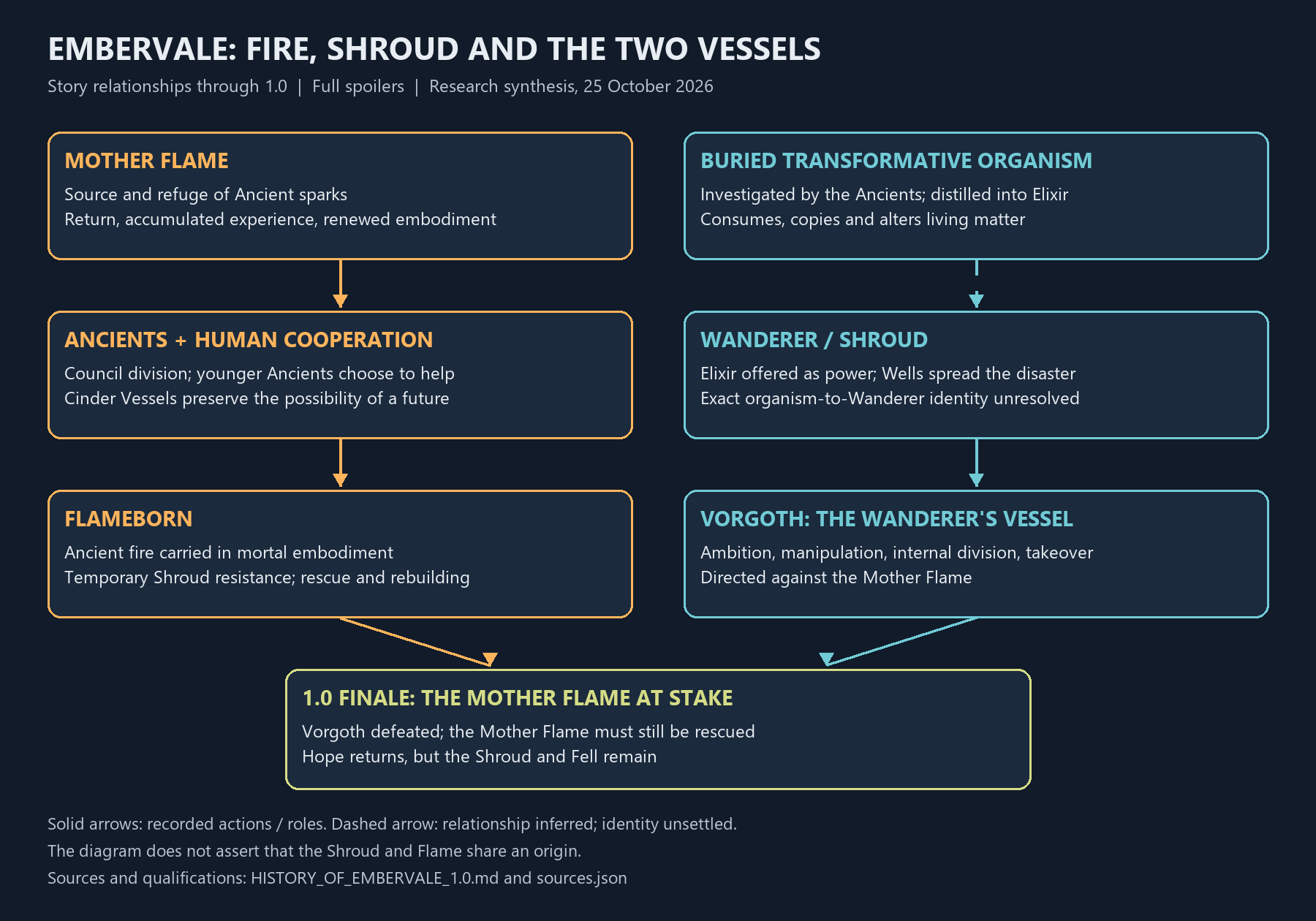
The visible fog is one manifestation of a larger transformative danger. Ancient laboratory records describe cells that consume organic material, then replicate or alter it. The distilled product is invigorating, pain-relieving, and habit-forming, with concerning side effects. Elixir is therefore a preparation derived from the organism; the Shroud is the wider corrupting phenomenon, rather than simply another name for a bottle of Elixir. Test Subjects
Balthazar's spore model explains how he thinks the fog spreads. It should remain attributed to him. The tutorial confirms the practical effect: prolonged exposure kills even a Flameborn. Theories II, The Shroud tutorial
What is the Flame?
An Ancient spark needs a shell. It returns to the Mother Flame and is sent out again with individual memory erased. Thoughts On Eternity
The Flameborn carries an inner Flame that protects against Shroud exposure temporarily and connects them to Ancient systems. A base altar, an individual's inner fire, and the Mother Flame should be described in their distinct roles. The checked texts do not establish a complete technical account of how every manifestation is related. The Flame tutorial
What did the Ancients do?
Their history includes investigation of the danger, concealment, and disagreement over human involvement. The council's record explicitly acknowledges that humans have discovered Elixir and fails to settle a noninterference motion. This supports a history of divided responsibility, not a uniformly benevolent or uniformly malicious Ancient civilisation. Council proceedings
Their flight also fails to create a clean separation. Energy diverted to ascent weakens a barrier, Vorgoth's army breaches it, and the elevated refuge remains vulnerable. The Ancients Flee
How does Vorgoth become the Wanderer's vessel?
The evidence supports a progression:
- Susceptibility: Vorgoth already fears and resents the Ancients.
- Enticement: Elixir appears to vindicate his ambitions and suspicions.
- Dependence and ideological capture: the Wanderer's explanations become the framework through which he interprets events.
- Internal division: his writings describe more than one presence or rhythm within him.
- Embodiment: the final boss's second phase bears the explicit title the Wanderer's Vessel.
The early stages are grounded in Vorgoth's notes; the internal conflict and goal in Ruminations; the endpoint in boss data.
Interpretation: this is progressive takeover rather than a simple political alliance. The exact moment his independent will is lost, and the precise biological or magical transfer mechanism, are unestablished by these sources.
Why attack the Mother Flame?
Vorgoth believes the Ancients are preparing fire against his people. His own text attributes the demand to extinguish the Mother Flame to the Wanderer, linking it to becoming whole. That is the antagonist's account and justification, not proof that the Ancients planned the attack he fears. Ruminations
Interpretation: destroying her would imperil Ancient renewal, making her a strategic target. Thoughts On Eternity
Are the Shroud and Flame the same power?
Not established. Shared imagery of unity does not prove shared origins. Renewal through the Flame and consumption by the Shroud invite comparison, while their exact cosmological relationship remains unresolved. Thoughts On Eternity, Test Subjects
For a documentary, a useful interpretation is that the two vessels embody different outcomes of joining powers: the Flameborn makes renewal possible, while Vorgoth's vessel culminates in the loss of himself. Present that as a reading of the story, not a quotation from its narrator.
CHAPTER 05
The 1.0 ending and its limits
The final quest distinguishes defeating Vorgoth from rescuing the Mother Flame. Community descriptions of the concluding cinematic report the Flameborn giving their inner fire to save her, with the hero remembered for the resulting renewal. This detailed sacrifice account has secondary-source support in this research, rather than a directly verified transcript of the ending. Flameborn account, Ending walkthrough
That account should not be flattened into the gameplay claim that the save or character is deleted: play continues after the cinematic. Conversely, continued play is not proof that the cinematic contains no sacrifice. Ending walkthrough
Keen's own 1.0 notes establish the essential limit: the current storyline concludes, but the Shroud remains and the Fell continue threatening territory. The ending creates hope and the possibility of restoration. It does not establish the destruction of every trace of the organism, the Wanderer's permanent cosmic annihilation, or the restoration of every Ancient. Official changelog
CHAPTER 06
Claims to keep qualified in narration
| Claim | Treatment |
|---|---|
| The Ancients created the Shroud from nothing. | Unsupported. They investigated a pre-existing organism. |
| The Wanderer is definitely an Ancient, a particular human, or a named god. | Unresolved in the examined sources. |
| The Wanderer and every part of the Shroud are literally one identical being. | Strong thematic/biological connection; the exact identity relationship needs qualification. |
| The Wanderer took the missing laboratory sample. | Suggested by circumstantial evidence; the research note does not identify the visitor. |
| Vorgoth was an innocent man until possession. | Contradicted by his already hostile outlook; corruption compounds his choices. |
| Every Ancient approved abandoning humanity. | Contradicted by the recorded council division and Ezramin's position. |
| The Flame is uncomplicated individual immortality. | Too simple: the spark cycle raises questions about memory and identity. |
| Defeating Vorgoth removes all Shroud. | Contradicted by the official 1.0 notes. |
CHAPTER 07
Suggested documentary sequence
- The king who became a vessel: open with Vorgoth and the question of who is acting through him.
- Before human memory: introduce the Ancient account of arrival and the buried danger.
- A gift in a blue flask: use the dated audience to enter human political history.
- Wells, war, and the collapse: move from extraction to the siege and civilian witnesses.
- The divided Ancients: explain the Mother Flame, council split, ascent, and failure to escape.
- A soul carried by fire: follow the experiments and preservation effort into the Flameborn.
- The Wanderer's Vessel: explain the takeover and assault on the Mother Flame.
- An ending with work left to do: distinguish sacrifice, continued play, and the surviving Shroud.
This chapter plan is a proposed editorial structure, not a finished voice-over script. Before recording exact quotations or the final sacrifice wording, check the English 1.0 journal and replayable outro directly. All prose above is paraphrased except brief in-game names and titles.
KEEP EXPLORING
Downloads & sources
Keep a copy for reference, or share the timeline in Discord.
Separate Discord messages: Message 1 · Message 2 · Message 3
Browse all 31 source references
- Legacy of the Ancientsgame text transcription
- Council proceedingsgame text transcription
- Ezramingame text transcription
- Metamorphismgame text transcription
- Elixir Cultivationgame text transcription
- The Selectiongame text transcription
- Notes By Lord Vorgothgame text transcription
- Theories Igame text transcription
- A Scattered Legacygame text transcription
- Dam reportsgame text transcription
- The Ascentgame text transcription
- Cinder Vaultgame text transcription
- Jezmina's journeygame text transcription
- Loraine's field notesgame text transcription
- Captain's Journalgame text transcription
- The Flame tutorialgame text transcription
- Survivor questreported game data
- Boss datareported game data
- Final quest accountsecondary ending account
- Official 1.0 changelogofficial developer
- Ruminationsgame text transcription
- Hearing Voicesgame text transcription
- Manathor on eternitygame text transcription
- The Ancients Fleegame text transcription
- Withstanding the Shroudgame text transcription
- Queen Pikemead's Statuegame text transcription
- Athalan's Letter To Taliongame text transcription
- Darya's Remorsegame text transcription
- Test Subjectsgame text transcription
- Flameborn accountsecondary ending account
- Ending walkthroughsecondary ending account
Research checked 25 October 2026. Journal text was consulted through online transcriptions. The precise ending sacrifice wording remains supported by secondary accounts pending a direct in-game check.